Priceline
Expertise
We gave Priceline's AI travel assistant a visual and motion identity that turns the way an agent thinks into something travelers can see.
Overview
Designing the brand and motion identity for Penny, Priceline's AI travel assistant
Penny was already serving more than 3 million travelers when Priceline made a strategic decision to upgrade the experience to match its ambition for the product.
Penny could already answer travel questions, find hotels, and help travelers troubleshoot bookings. The technology behind it was strong. But the interface still looked and felt like every other chatbot in travel. For a product Priceline saw as central to its future, that left room to grow.
Over 8 weeks, Priceline partnered with Fantasy to evolve Penny from a feature living inside the app into its own AI travel assistant brand, with a visual and emotional vocabulary as strong as its capabilities.
Our Objectives
- 01.
- Turn the latency of an AI agent into comprehension through expressive visual and motion cues
- 02.
- Give Penny a distinct personality for Priceline's digitally native travelers
- 03.
- Move Penny from a chatbot feature toward a stand-alone AI travel brand
- 04.
- Deliver a modular identity Priceline can grow on its own as Penny's capabilities expand
A visible way of thinking
An AI travel agent doesn't respond instantly, doesn't always sound certain, and doesn't have the same abilities from one week to the next.
Instead of hiding that, the interface treats it as a design problem: every moment Penny is listening, thinking, or replying gets its own visual cue, and that same visual language has to keep working as Penny's capabilities expand.
That's what turns "Penny's stuck" into "Penny's working on it," and a new capability into something that feels like it was there all along, because it speaks the same visual language as everything else.
The expressive AI interface
An avatar with expressive states
Passive, listening, thinking, and generating states make the invisible work of an AI agent visible to travelers.
Motion as a way to manage latency
Orbflow patterns, a budget-to-luxury slider, and card-generation animations give travelers a running sense of what Penny is doing while it works.
Recovery as part of the journey
A 'no exact match' becomes a natural next step in planning rather than a dead end, with language that keeps travelers moving toward a booking.
I love it. I can already sense this is going to look and feel a lot more modern and provide users a fun and more enjoyable journey.Kevin Heery, CPO, Priceline
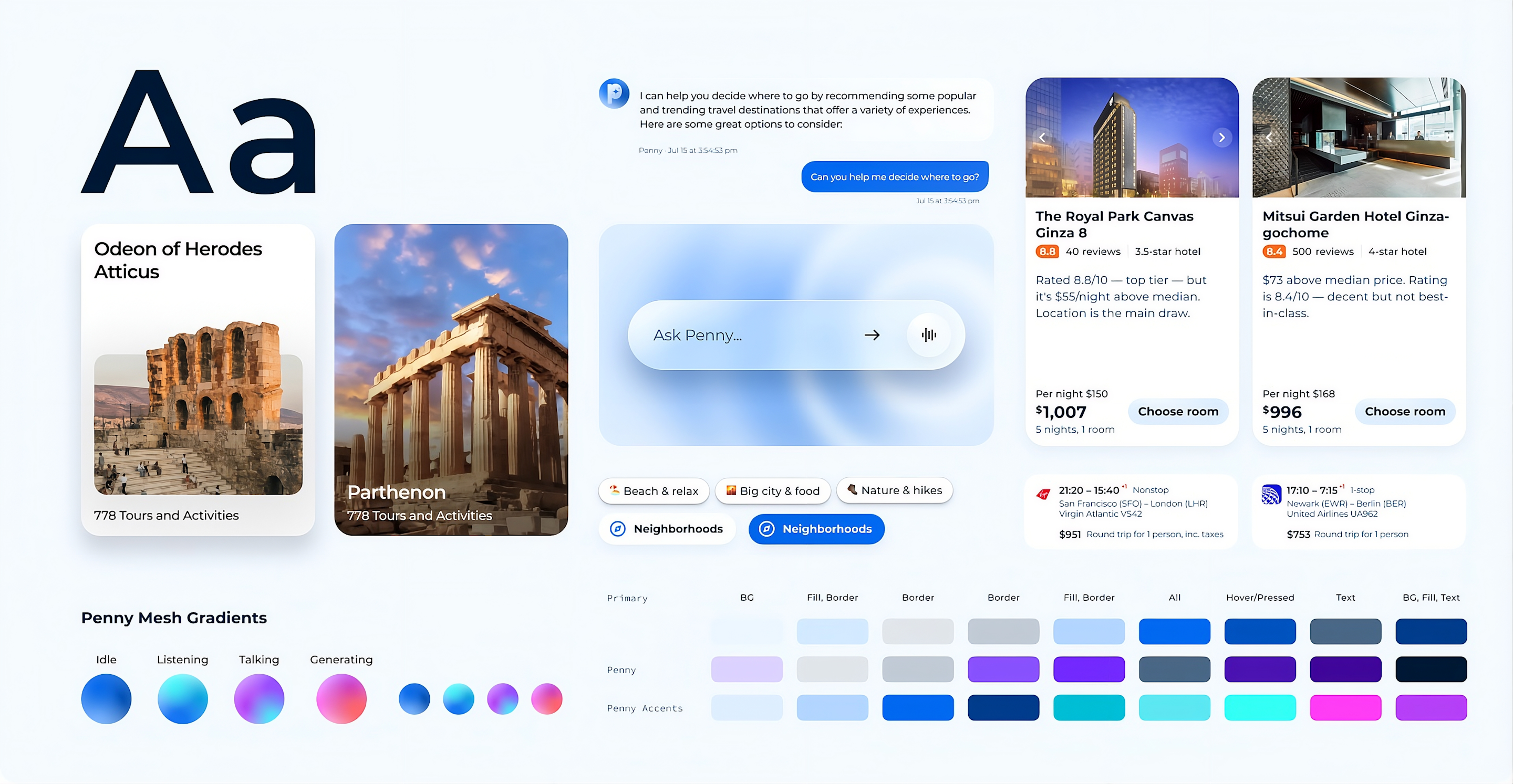
A modular interface language designed to grow
The AI travel planning category has weak design standards, with most products offering text-only interfaces and no real identity system.
Fantasy built a modular interface language instead, where every part, from the avatar's behaviors to the Figma toolkit, is structured for Priceline to apply across any flow or surface and to extend as Penny grows. Seasonal moments like Cyber Week were designed in from the start.
Penny, brand and motion design
Brand and motion design by Fantasy for Penny, Priceline's AI travel assistant.
The Impact
A brand identity that scales with Penny's expanding intelligence
The redesigned Penny launched in November 2025, and Priceline deployed the system to the Penny Portal, one of the primary interfaces serving millions of travelers.
OpenAI recently pointed to Priceline as its example of what happens when all three of its new voice AI patterns come together, picturing a future where travelers search for flights and hotels, rebook after a delay, and check TSA wait times, all by talking to Penny.
We are seeing a noticeable uplift from users who engage with Penny compared to non-Penny users.Glenn Fogel, CEO, Booking Holdings